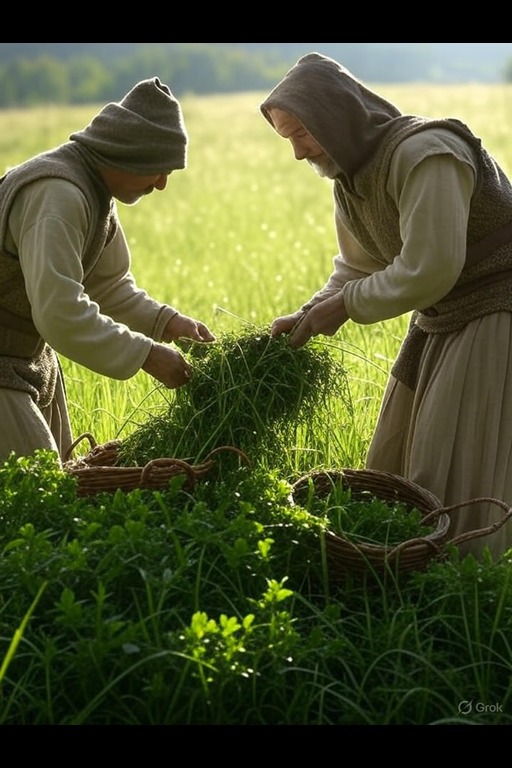
Grazing Fodder (Wild) refers to the diverse array of grasses and plants that flourish in open grasslands. This resource is collected with minimal tools, emphasizing the importance of sustainability and careful selection. Gatherers meticulously sort through the material, discarding any that does not meet the standards for use. The sound fodder that remains serves as a cornerstone for various crafts and trades, playing a vital role in local economies.
Universal
Biomes
Politics
Alignments
Races
Resources
Classes
Elevations
Religions
World
No accessible MAPs found.
Biome
Politics
Alignment
Race
Resource
Class
HeightMap
Grazing Fodder (Wild)
Detailed Description
In the expanse of grasslands, Grazing Fodder (Wild) emerges as a crucial resource, providing sustenance for both livestock and those who depend on it. Gatherers venture into these vibrant landscapes, often during the early morning or late afternoon, when the dew still clings to the blades of grass. Their task is to identify and harvest plants that are healthy and robust, ensuring that only the best material is collected. This practice not only supports local animal husbandry but also sustains the delicate balance of the ecosystem within these open spaces. The process of gathering involves a keen eye and an understanding of the various species that thrive in grasslands. Gatherers use simple tools, such as sickles or even their hands, to carefully cut the desired plants without damaging the surrounding flora. The selection process is critical; any decayed or diseased plant material is set aside, as it could compromise the health of animals that consume the fodder. In this way, the gatherers contribute to the well-being of their livestock and the preservation of their environment. Once harvested, the fodder is often sorted at the edge of the grassland, where the gathered material is laid out for careful inspection. This sorting is not merely a practical task but a ritual of respect for the land and its resources. Only the finest specimens make it into storage, where they are prepared for various uses. Whether destined for craft goods, construction materials, or trade, Grazing Fodder (Wild) is valued for its versatility and reliability. Its applications can be far-reaching, underpinning local economies and crafting traditions, as well as facilitating transport and building endeavors. In crafting, the processed fodder can be transformed into products that support the daily lives of communities. For example, it can be woven into durable mats or utilized as stuffing for tools. The construction industry also finds value in this resource, using it as a natural insulation material or as part of composite structures. In trade, the quality and quantity of fodder can dictate its value, making it a sought-after commodity in regions where arable land is scarce or where livestock farming is prevalent.
Examples
Common examples of products derived from Grazing Fodder (Wild) include a variety of craft goods, such as woven mats and durable blankets. In construction, it may be used as insulation or filler in walls, enhancing both the warmth and the structural integrity of buildings. Additionally, this resource serves as essential trade goods, providing sustenance for livestock or material for crafting tools. Overall, its applications underscore the importance of this resource in supporting both daily life and economic exchange.