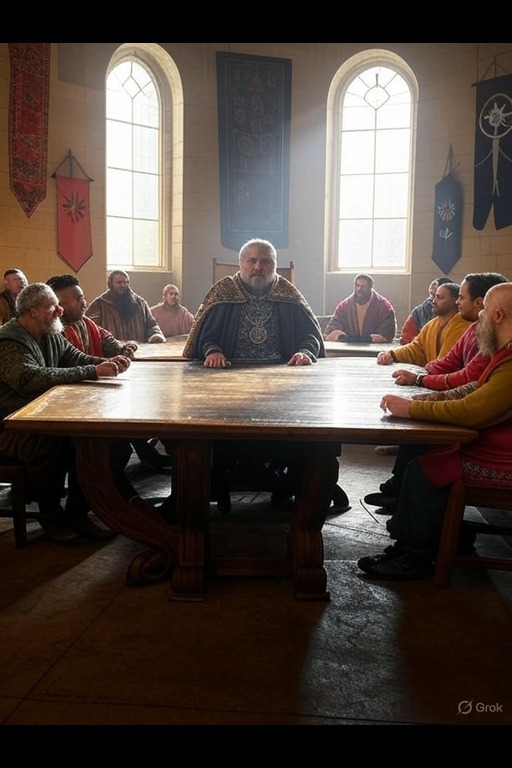
A Khanate operates under a monarchical system led by a khan, emphasizing military prowess and tribal alliances to maintain authority and order over its territories.
Universal
Biomes
Politics
Alignments
Races
Resources
Classes
Elevations
Religions
World
No accessible MAPs found.
Biome
Politics
Alignment
Race
Resource
Class
HeightMap
Khanate
Detailed Description
In a Khanate, the khan serves as the supreme ruler, wielding significant military and political power derived from their lineage and martial prowess. Succession often follows a hereditary principle, where the eldest son or a chosen heir from the khan’s bloodline inherits the title, although this can lead to power struggles among rival factions within the ruling family. The khan’s authority is typically reinforced by a council of tribal leaders or nobles, known as the Kurultai, who advise on matters of governance, military campaigns, and resource allocation. Their influence varies, with some councils holding substantial sway, while others merely serve as a rubber stamp for the khan's decisions. This system is heavily reliant on personal loyalty and kinship ties, which can lead to both strong unity and deep rivalries. In practice, governance in a Khanate can be both centralized and decentralized. Local leaders, often referred to as beys or chieftains, administer rural regions and manage local issues, but they ultimately answer to the khan’s authority. Taxation is typically minimal, relying on tribute or resource sharing from vassal tribes and settlements, and the khan often emphasizes martial service over monetary contributions. Laws are enforced through customary practices and edicts issued by the khan, with a strong focus on maintaining order and honor among the tribes. Subjects may experience a mixture of stability and insecurity; while tribal loyalty can foster a sense of community, the potential for conflict among clans often leads to periodic skirmishes and shifting allegiances. The Khanate's military plays a crucial role in both defense and expansion, with the khan at its helm. Warriors are highly esteemed, and their valor in battle often dictates their social standing. In times of peace, the military may be involved in policing and protecting trade routes, reinforcing the khan's control over the land. Meanwhile, religious leaders might hold an important cultural role, providing spiritual guidance and legitimizing the khan's rule through divine sanction. This intertwining of religion and governance can lead to conflicts, especially if spiritual leaders challenge the khan's authority or if differing belief systems emerge within the realm. Overall, the Khanate system embodies a complex interplay of power, loyalty, and tradition, shaping both the rulers and the lives of their subjects in profound ways.
Examples
A tribal faction challenges the khan's authority, seeking to increase their own influence amidst rising tensions. A khan faces dissent after favoring one clan over others, risking civil strife. A newly appointed bey struggles to maintain order in a remote valley plagued by raiders. A high-stakes gathering of tribal leaders reveals a conspiracy against the khan, testing loyalties. An ambitious warlord within the khan's ranks seeks to carve out his own domain, threatening the unity of the realm.