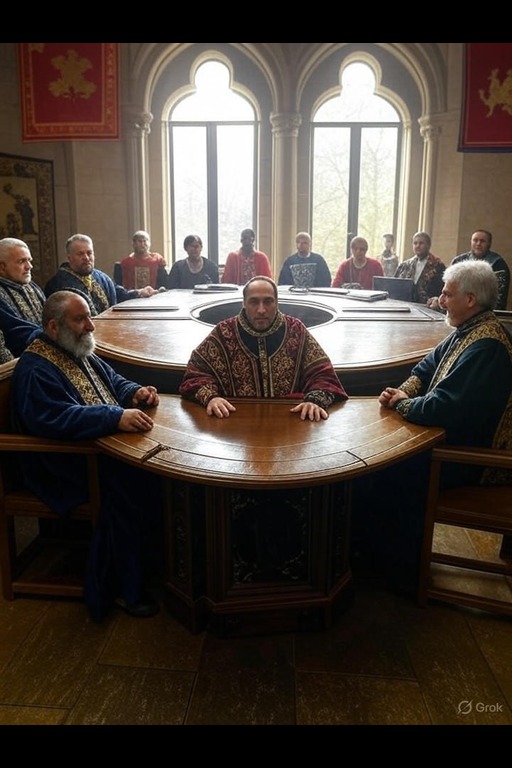
A governorate serves as a localized administrative unit led by a governor, balancing regional needs with overarching authority from a sovereign power.
Universal
Biomes
Politics
Alignments
Races
Resources
Classes
Elevations
Religions
World
No accessible MAPs found.
Biome
Politics
Alignment
Race
Resource
Class
HeightMap
Governorate
Detailed Description
In a governorate, governance typically revolves around a governor who wields significant authority, often appointed or elected based on the dynamics of the ruling power, such as a kingdom, empire, or federation. The governor's role is to enforce laws, manage resources, and oversee public welfare while also maintaining loyalty to the higher authority. Governance structures may incorporate councils composed of local notables or representatives, ensuring that various community interests are represented in decision-making processes. These councils can vary widely in influence; in some systems, they wield substantial power, while in others, they merely serve as advisory bodies lacking real clout. Succession within a governorate can take on different forms depending on the nature of the governing body. In a kingdom, a governor may inherit their position or be selected from a royal family, while in a republic, elections may dictate who assumes this role. Empires might impose governors from a central authority, leading to potential tensions between local interests and imperial mandates. In federations, the degree of autonomy granted to governorates can fluctuate, allowing for a spectrum of local governance styles and the possibility for greater self-determination, which can foster regional pride or resentment towards the central government. Socially, life in a governorate reflects a blend of local customs and the overarching influence of the parent state. Citizens may experience a complex relationship with their governor, viewing them as either a protector of local interests or a representative of distant authority. Law and taxation procedures, often established by the governor and their council, impact daily existence significantly. Local traditions may be upheld or suppressed, depending on the ethos of the ruling power, leading to pockets of unrest or flourishing cultural identities. The presence of a local military or religious institution can further complicate this dynamic, either acting as a stabilizing force or a means of oppression. In summary, the governance of a governorate provides a unique blend of local and centralized authority, shaping the social fabric and political landscape of its inhabitants, and leaving room for intrigue and conflict under various larger regimes.
Examples
A governorate within a kingdom struggles against feudal lords claiming rival rights. An imperial district faces unrest as its appointed governor neglects local customs. A federation's canton advocates for greater autonomy, sparking debates in the capital. A provincial enclave in a republic promotes reform, challenging outdated laws. An eparchy in a theocracy balances spiritual duties with civic governance, often leading to tension with the secular populace.