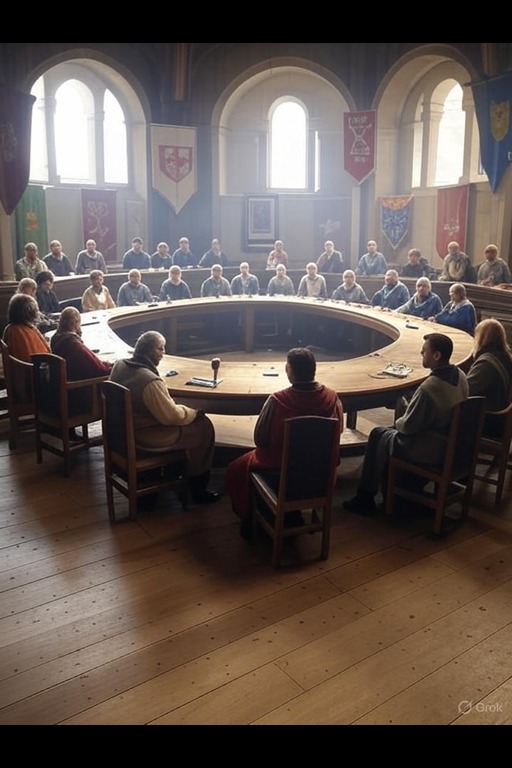
This political structure features a confederation of semi-autonomous provinces, each governed by a council that balances local interests with collective cooperation among member states.
Universal
Biomes
Politics
Alignments
Races
Resources
Classes
Elevations
Religions
World
No accessible MAPs found.
Biome
Politics
Alignment
Race
Resource
Class
HeightMap
Blank
Detailed Description
In this confederation, power is distributed among various provinces, each with its own governing council. These councils are composed of representatives elected by local communities, ensuring that provincial interests are voiced and considered in a broader political arena. The confederation operates on principles of mutual assistance and collective defense, fostering a sense of unity while allowing for regional autonomy. Each province retains significant control over its own laws and taxation, leading to a diverse tapestry of governance across the confederation. This can result in distinct differences in tax rates, legal codes, and civic duties that reflect local customs and needs. Succession within this political structure often follows a system of electoral succession, where council members serve predetermined terms but can be re-elected based on the approval of their constituents. This system reinforces accountability, as representatives must remain in touch with the sentiments of their populace to retain their positions. In the event of a council head’s untimely departure, a temporary council member is chosen to ensure stability until a special election can be arranged. The emphasis on local leadership tends to cultivate strong community bonds, though it can lead to friction when provincial interests clash with confederation-wide policies. Daily life under this confederation varies greatly from province to province, often reflecting the unique cultural, economic, and social dynamics of each area. Citizens may experience different levels of government services, ranging from robust public education systems to more rudimentary provisions, depending on the province's priorities and financial health. The confederation’s reliance on voluntary military alliances means that provinces are primarily responsible for their own defense, leading to variations in military preparedness and local militias. Additionally, the presence of provincial laws often creates a patchwork legal environment where individuals must navigate different systems depending on their locale, which can be both beneficial and burdensome. Citizens can actively participate in local decision-making processes, fostering a sense of empowerment while also leading to heated debates and tensions during council meetings. Overall, this political structure offers a blend of community engagement and governance challenges, shaping a complex landscape of power and responsibility.
Examples
A coastal province enacts strict fishing regulations to protect dwindling marine resources, causing unrest among local fishermen. A council head faces accusations of corruption, leading to a major political scandal that tests the integrity of the entire confederation. A border province sees an influx of refugees, prompting a heated debate about resource allocation and humanitarian aid. An alliance of provinces jointly invests in a shared university, enhancing educational opportunities while sparking debates over funding priorities. A newly formed militia in a remote province challenges traditional authority, seeking greater autonomy in regional security matters.