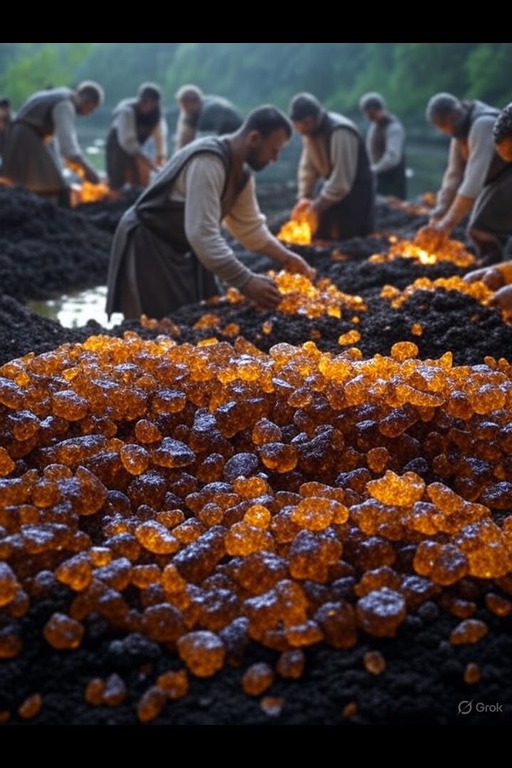
Amber Fragments are the remnants of ancient organic matter, typically found embedded in wetland environments. These minerals are extracted from beds and terraces, where they are quarried or scooped directly from the earth. The fragments vary in size, with larger blocks often being cut for use in construction, while smaller pieces may be refined into glass or ceramics. Their versatility makes them valuable trade goods across various industries.
Universal
Biomes
Politics
Alignments
Races
Resources
Classes
Elevations
Religions
World
No accessible MAPs found.
Biome
Politics
Alignment
Race
Resource
Class
HeightMap
Amber Fragments
Detailed Description
Amber Fragments originate from the decomposition of organic material over millennia, often in environments rich with moisture. The process of formation involves complex chemical reactions and the gradual compression of plant matter, which results in the creation of a durable and appealing mineral. Found primarily in wetland biomes, these fragments are excavated from layers of sediment, where they have been preserved over time, awaiting discovery by eager quarry workers. This unique extraction process requires both skill and knowledge of the land, as the best deposits often lie beneath layers of soil and vegetation. The quarrying of Amber Fragments involves a careful balance between efficiency and preservation. Workers employ various methods, from hand tools to more mechanized solutions, to extract the mineral without causing undue damage to the surrounding ecosystem. Once removed from the earth, the fragments are sorted according to size and quality, with larger pieces often earmarked for construction purposes while finer materials are processed for other industries. The ability to transform raw amber into viable products is a testament to the ingenuity of those who work with it, as they harness its properties for a multitude of uses. In construction, Amber Fragments are prized for their aesthetic appeal and durability. They can be cut into stone blocks that serve as both structural elements and decorative accents in buildings. When heated, smaller pieces yield a beautiful glass, which is sought after for its clarity and brilliance. Moreover, ceramics crafted from amber-infused clays exhibit unique characteristics, providing artisans with endless creative possibilities. Aside from their practical applications, Amber Fragments hold economic significance as trade goods, facilitating commerce between regions and cultures. The multifaceted nature of Amber Fragments contributes to their enduring popularity across various industries. As a resource, they foster not only construction and artistic endeavors but also serve as a link between communities through trade. The ongoing demand for amber-derived products ensures that this mineral remains a staple in the marketplace, driving innovation in its extraction and application.
Examples
Common products derived from Amber Fragments include cut stone utilized in building facades and interiors, as well as glass used in both functional and decorative items. Ceramics made from amber-enhanced clays tend to display distinctive textures and colors, appealing to both craft enthusiasts and commercial buyers. In trade, Amber Fragments are exchanged for other resources, solidifying their role as a staple commodity. Additionally, the versatility of amber makes it a preferred choice in artistic ventures, inspiring countless creations across the realms.