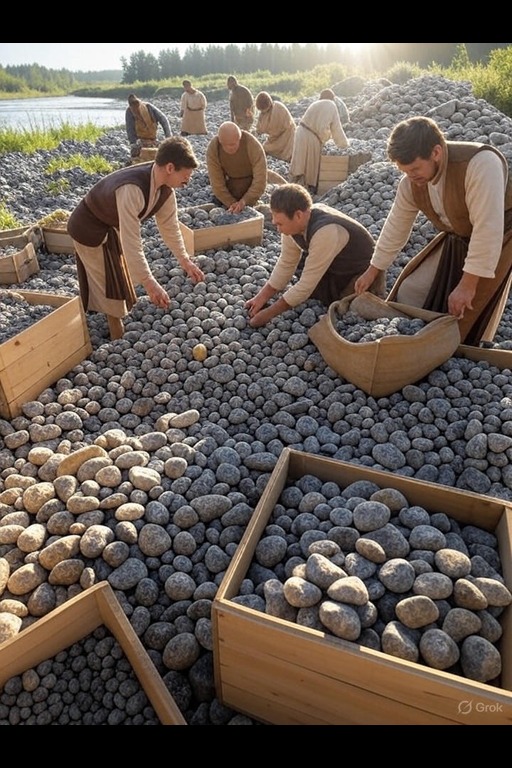
Pebble Aggregate is a versatile resource found in grasslands, where it is often excavated or collected from natural outcrops and riverbanks. This material is carefully graded at the site of collection, with useful pieces set aside for various applications. The larger fragments are typically packed into crates for transport, while finer particles are dried and bagged, commonly intended for use in kilns or as mortar. Its widespread utility makes it a cornerstone of several industries, including masonry and construction.
Universal
Biomes
Politics
Alignments
Races
Resources
Classes
Elevations
Religions
World
No accessible MAPs found.
Biome
Politics
Alignment
Race
Resource
Class
HeightMap
Pebble Aggregate
Detailed Description
Originating from the naturally occurring deposits found across expansive grasslands, Pebble Aggregate is formed through the gradual weathering and erosion of rocks. Over time, these aggregates accumulate in riverbeds and along hillside outcrops, producing a range of sizes that contribute to its practical applications. The collection process often involves careful excavation, ensuring minimal disruption to the surrounding environment while maximizing yield from the earth. Once collected, the Pebble Aggregate is sorted on-site, where workers differentiate between the larger, more robust pieces suitable for structural applications and the finer grains that serve different purposes. The larger stones are commonly employed in masonry, where their durability makes them ideal for constructing walls, foundations, and other architectural features. Craftspeople meticulously select pieces based on shape and size, ensuring a sturdy end product that can withstand the test of time. In the realm of pottery, the finer particles are invaluable; they can be mixed with clay to improve texture and strength, creating ceramics that are both functional and aesthetically pleasing. Additionally, the aggregate finds its way into brick and tile production, where it contributes to the material's resilience and thermal properties, making these items essential for both construction and art. Transportation of Pebble Aggregate typically involves packing the graded stones into sturdy crates, which facilitates easier movement to construction sites and workshops. The fines, having been dried and bagged, are often sold as trade goods, making them a sought-after commodity for merchants operating in various markets. The ability to easily transport and utilize this resource has made it an integral part of trade networks, linking producers to craftsmen and builders across vast distances. As such, Pebble Aggregate not only serves as a fundamental building material but also plays a significant role in the economic exchanges that underpin many communities. Ultimately, Pebble Aggregate represents a blend of natural utility and craftsmanship, embodying the connection between the earth and human creativity. Its diverse applications across industries ensure that it remains a cherished resource, appreciated for both its functionality and its role in enabling the construction of lasting structures and artistic creations.
Examples
Various products arise from the utilization of Pebble Aggregate, showcasing its versatility across different industries. In masonry, it contributes to the creation of durable bricks and tiles, essential for building robust structures. Pottery artisans incorporate the finer aggregate into their clay mixtures, resulting in ceramics that are known for their strength and beauty. Additionally, cut stone crafted from larger pieces of Pebble Aggregate serves as a foundational element in significant architectural endeavors. In trade, these aggregates are packaged as goods, facilitating economic transactions in numerous marketplaces.