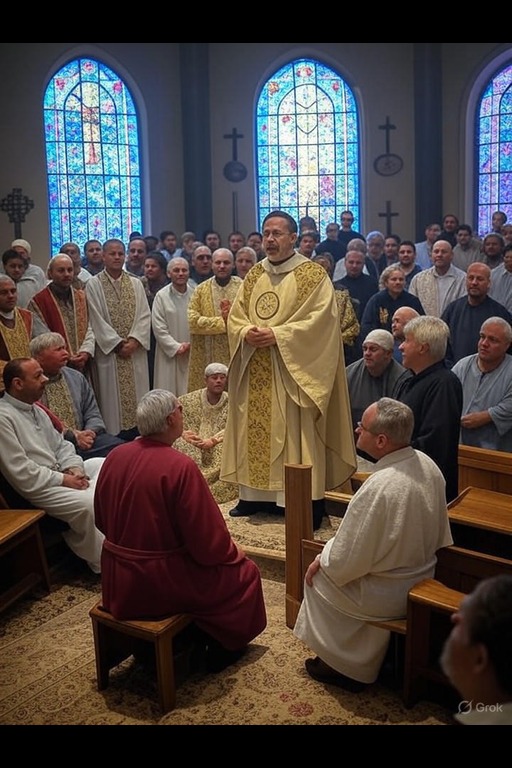
A church division governed by a priest fosters spiritual leadership and community cohesion, guiding the parish through pastoral care while navigating the complexities of local governance.
Universal
Biomes
Politics
Alignments
Races
Resources
Classes
Elevations
Religions
World
No accessible MAPs found.
Biome
Politics
Alignment
Race
Resource
Class
HeightMap
Parish
Detailed Description
In this political structure, the parish serves not only as a religious community but also as a crucial administrative unit. A priest, chosen from among the congregation or appointed by a higher ecclesiastical authority, holds primary power and is responsible for the spiritual and social well-being of the parishioners. Their pastoral care extends beyond mere worship; they often mediate local disputes, enact community initiatives, and oversee charitable deeds, creating a strong bond between the church and daily life. The priest's authority is typically supported by a council of elders or lay leaders who assist in governance, ensuring that both spiritual and practical matters are addressed, thus merging faith with local administration. In certain contexts, elders may even offer counsel in succession matters, establishing a lineage of leadership within the parish that aligns with the traditions of the community. In this manner, succession can vary; while some parishes may follow a hereditary model, others may elect their leaders based on merit or community consensus. However, the overarching influence of the church can sometimes lead to tensions with secular authorities, especially in regions where governance is shared or contested between the church and the state. In terms of law and taxation, the parish often operates under a dual system where religious edicts coexist with local laws, creating a unique legal framework that reflects both ecclesiastical and civic principles. Taxation can take many forms, often involving a combination of tithes, communal contributions, and local levies, which fund church maintenance, community projects, and social services. The priest plays a pivotal role in explaining the purpose of these contributions, which can either strengthen community ties or foster resentment if perceived as burdensome. The military role of the parish, if any, usually manifests through the mobilization of community defense forces or participation in larger regional conflicts, emphasizing a collective identity that is rooted in faith. While some parishes enjoy a high degree of autonomy under supportive kingdoms or federations, others may find their authority curtailed by centralized power structures or theocratic mandates. As such, the experience of parishioners can vary widely; some may revel in a deep-seated sense of community and belonging, while others may struggle against the constraints of rigid governance. This duality shapes the everyday lives of those within the parish, often creating a dynamic interplay of faith, governance, and identity that defines the parish's character in its broader political context.
Examples
A parish within a kingdom faces challenges as a powerful noble attempts to assert control over church lands. An eparchy in a theocracy thrives, as its priest consistently advocates for the needs of the local populace. A governorate in an empire struggles with religious dissension amidst calls for greater autonomy from the central authority. A commune in a federation unites various faiths to foster inter-religious dialogue and collaboration in local governance. A province in a republic witnesses heated debates about taxation and land use amidst changes in pastoral leadership.