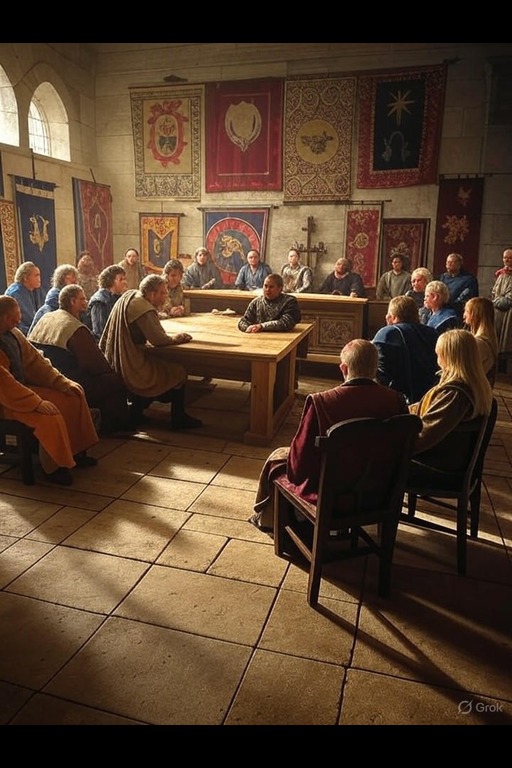
This political structure features a blend of local governance and central authority, allowing for diverse leadership and varying degrees of autonomy across its islands.
Universal
Biomes
Politics
Alignments
Races
Resources
Classes
Elevations
Religions
World
No accessible MAPs found.
Biome
Politics
Alignment
Race
Resource
Class
HeightMap
Islands
Detailed Description
The governance of these islands is often characterized by a balance between local autonomy and overarching influence from a central authority. Power typically resides with a local ruler, such as a governor or a magistrate, who is responsible for the administration of laws, taxation, and military organization. In some contexts, they may be appointed by a larger governing body, such as a king or a council, while in others, local leaders might be elected or inherit their positions through familial lines. The method of succession can thus vary widely; hereditary lines may dominate in feudal systems, while elections could be a hallmark of republican governance. This dynamic can lead to power struggles, especially in instances where the central authority seeks greater control over local affairs or when local leaders wish to assert their independence. In many cases, the local ruler serves as the primary authority on all matters of governance, including the administration of justice and the collection of taxes. Councils or assemblies, often composed of influential community members or representatives, may advise or assist in decision-making. The relationship between the local ruler and these councils can significantly affect daily life; in some regions, powerful councils can check a ruler's authority, while in others, they may simply serve as a rubber-stamp for the ruler’s decisions. Religious institutions may also play a critical role, particularly in theocratic systems, where local leaders must navigate the influence of spiritual authorities alongside their political mandate. Life under this system can be marked by a sense of community engagement or, conversely, by tension due to competing interests between local and central powers. Citizens may experience varying levels of bureaucratic efficiency, with some areas enjoying responsive governance and others grappling with corruption or inefficiency, often exacerbated by the duality of authority. The degree of autonomy granted to local rulers can foster a diverse tapestry of cultures and practices across the islands, leading to rich local traditions that may clash with the policies imposed by central governance. These nuanced dynamics create a vibrant, if sometimes volatile, political landscape that offers rich storytelling opportunities for those inhabiting or exploring these islands.
Examples
A duchy within a kingdom struggles to maintain its traditions against the encroaching influence of the crown. A governorate in an empire faces unrest as its citizens demand representation in the imperial assembly. A canton in a federation prides itself on its unique culture, fiercely defending its rights against federal mandates. An eparchy in a theocracy navigates the delicate balance of spiritual and temporal power amidst rising dissent. A province in a republic debates the legitimacy of its elected leader after a contested election.