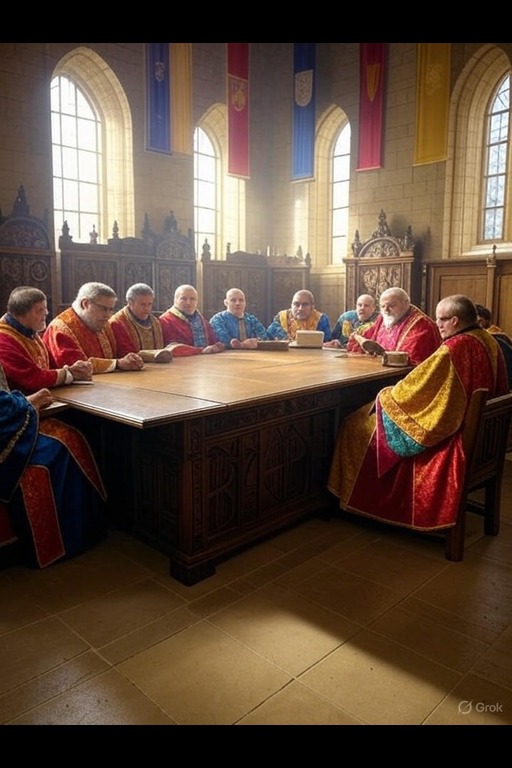
The Diaconate is a complex political structure where authority is distributed among religious leaders, local councils, and community representatives, fostering both spiritual guidance and administrative duties.
Universal
Biomes
Politics
Alignments
Races
Resources
Classes
Elevations
Religions
World
No accessible MAPs found.
Biome
Politics
Alignment
Race
Resource
Class
HeightMap
Diaconate
Detailed Description
In the Diaconate, governance is primarily rooted in religious authority, with power typically residing in an assembly of clergy known as the Council of Elders. This council is responsible for interpreting sacred texts, guiding community moral standards, and overseeing local governance. Leaders are chosen based on their spiritual merit, wisdom, and ability to connect with the populace, ensuring that candidates for power are not only knowledgeable but also respected within their communities. Succession often follows a blend of meritocratic and hereditary principles, where influential families may produce candidates, but must also demonstrate their piety and commitment to the community’s welfare. The Diaconate operates on a system of local councils, where representatives from various districts convene to address specific issues such as taxation, law, and communal welfare. These local councils possess a degree of autonomy, allowing them to make decisions that reflect the unique needs and beliefs of their constituents. In a kingdom, such councils may be subordinate to the overarching authority of a monarch, while in a theocracy, they may hold more significant power, acting as intermediaries between the divine and the people. Taxation is often based on tithes and offerings collected from the populace, with funds allocated for community projects, religious institutions, and support for the less fortunate. The impact of the Diaconate on daily life is profound, as citizens often view their governing bodies as extensions of their faith. Community gatherings, led by local leaders, foster a sense of unity and shared purpose. However, the intertwining of governance and religion can lead to tensions, particularly when secular interests conflict with spiritual mandates. The potential for corruption exists, especially in regions where power struggles between local councils and the Council of Elders emerge. Nevertheless, the Diaconate often thrives on its ability to adapt to both spiritual and temporal challenges, providing a framework for stability and communal resilience. In various contexts, the Diaconate can present different characteristics. Under a kingdom, local councils might operate with less independence, often required to align with royal decrees. In empires, the Diaconate may wield significant influence, allowing provinces to function almost autonomously while still adhering to overarching imperial laws. Federations might see a balance of power between the central authority and local religious councils, while in a theocracy, the Diaconate could serve as the principal governing body, blending both governance and religious leadership seamlessly.
Examples
A rural district governed by a local council faces a crisis of credibility as accusations of favoritism emerge. A margrave in a kingdom defies the Council of Elders, seeking to impose new taxes to fund a military campaign. In an empire, a well-respected cleric leads a movement advocating for greater autonomy from the central religious authority. A federation's council struggles to mediate disputes between competing sects, each vying for influence over local policies. A theocratic eparchy grapples with the fallout from a scandal that threatens to undermine the faith of its followers. A province within a republic holds biannual elections for its representative council, fostering a sense of civic engagement among the populace.