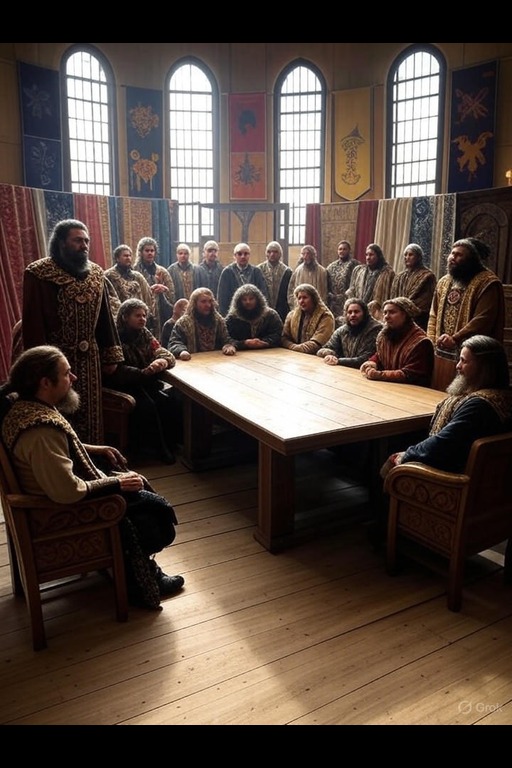
A confederation of diverse tribes and states, the United Hordes collectively govern through mutual consent while maintaining individual autonomy and unique customs.
Universal
Biomes
Politics
Alignments
Races
Resources
Classes
Elevations
Religions
World
No accessible MAPs found.
Biome
Politics
Alignment
Race
Resource
Class
HeightMap
United Hordes
Detailed Description
The United Hordes operates as an alliance of various tribes and states, each retaining a degree of sovereignty while collaborating for mutual defense and resource sharing. Power is decentralized, with each member tribe responsible for its own governance, customs, and laws. Representatives from each tribe gather at a central council, often referred to as the Grand Conclave, where decisions are made based on consensus or majority rule. This council is empowered to address matters affecting the confederation as a whole, such as defense strategies, trade agreements, and conflict resolution between tribes. However, the balance of authority can lead to tensions, as larger tribes may exert greater influence over council decisions than smaller ones, creating a dynamic often fraught with negotiation and dispute. Succession within the United Hordes is typically based on customs specific to each tribe. Leadership can range from hereditary positions to elected chieftains, with varying degrees of power. The Grand Chieftain, often seen as a symbolic leader of the confederation, is usually elected among the tribal leaders, representing the collective voice of the United Hordes. This position, however, does not override tribal autonomy. Instead, it serves to facilitate cooperation and symbolize unity. The complexities of succession are compounded by the need for tribes to balance their own interests against the demands of the collective, sometimes leading to internal strife. Daily life under the United Hordes is characterized by a blend of individual tribal customs and overarching confederate regulations. Tribes maintain their own laws and taxation systems, with the Grand Conclave handling matters that cross tribal boundaries. This can lead to a patchwork of legal experiences, as individuals may find their rights and obligations varying significantly based on their tribal affiliation. The military is typically organized at the tribal level, but in times of external threat, the confederation can call upon a united force composed of warriors from all tribes. Religious practices also vary widely, with tribes often celebrating their own deities or spiritual customs, yet participating in inter-tribal festivals that honor shared beliefs or ancestors. While the United Hordes provides a framework for cooperation, the challenge of maintaining a unified identity amidst diverse tribal traditions can create social friction and competition for resources.
Examples
A newly allied tribe struggles to integrate its customs into the existing council framework. A seasoned chieftain faces challenges in rallying support for a common defense against an external threat. Disputes arise over trade routes between neighboring tribes, leading to calls for arbitration. A charismatic leader seeks to challenge the Grand Chieftain's authority, igniting debates over the balance of power. Seasonal gatherings showcase both unity and the underlying rivalries among tribes, with tensions simmering just below the surface.